
Updated on May 29, 2026 Reduction of Environmental Impacts
- Chemical Substances
- Waste
- Water Resources
- Biodiversity
Emission Management of Chemical Substances
Based on the Law Concerning Reporting, etc. of Pollutant Release and Transfer Register (PRTR Law), the Kuraray Group in Japan surveys and ascertains the annual emissions of chemical substances subject to PRTR Law and reports the results to the national government. The Kuraray Group similarly discloses on its official website, etc. emissions of chemical substances not only covered by the PRTR Law, but also designated by the Japan Chemical Industry Association (JCIA). In addition to these chemical substances, we are taking the actions indicated in the table below with regard to persistent organic pollutants (POPs), volatile organic compounds (VOCs), hazardous atmospheric pollutants (HAPs), and particulate matter (PM).
| Classification | Chemical substances | Actions to be taken |
|---|---|---|
| POPs | Polychlorobiphenyl (PCB) | Storing, managing, reporting and detoxification treatment and disposal in accordance with the Law Concerning Special Measures against PCB Waste, which stipulates deadlines for treatment; high-concentration PCB wastes have been detoxified by the end of March 2026, and low-concentration PCB wastes are expected to be detoxified by the end of March 2027. |
| Dioxin and the like | Included as substances in the pollutant release and transfer register (PRTR) and emissions are measured and reported as PRTR substances. | |
| Substances other than the above | Not applicable to Kuraray manufacturing and use | |
| VOC HAP | Included as substances in the pollutant release and transfer register (PRTR) and emissions are measured and reported as PRTR substances. (Total emissions are reported in >Material Flow.) | |
| PM | Emissions of particles of soot are reported in >Material Flow | |
| PRTR | Emissions of substances applicable to the law and to the list compiled by the Japan Chemical Industry Association are measured and reported (Total emissions are reported in >Material Flow.) | |
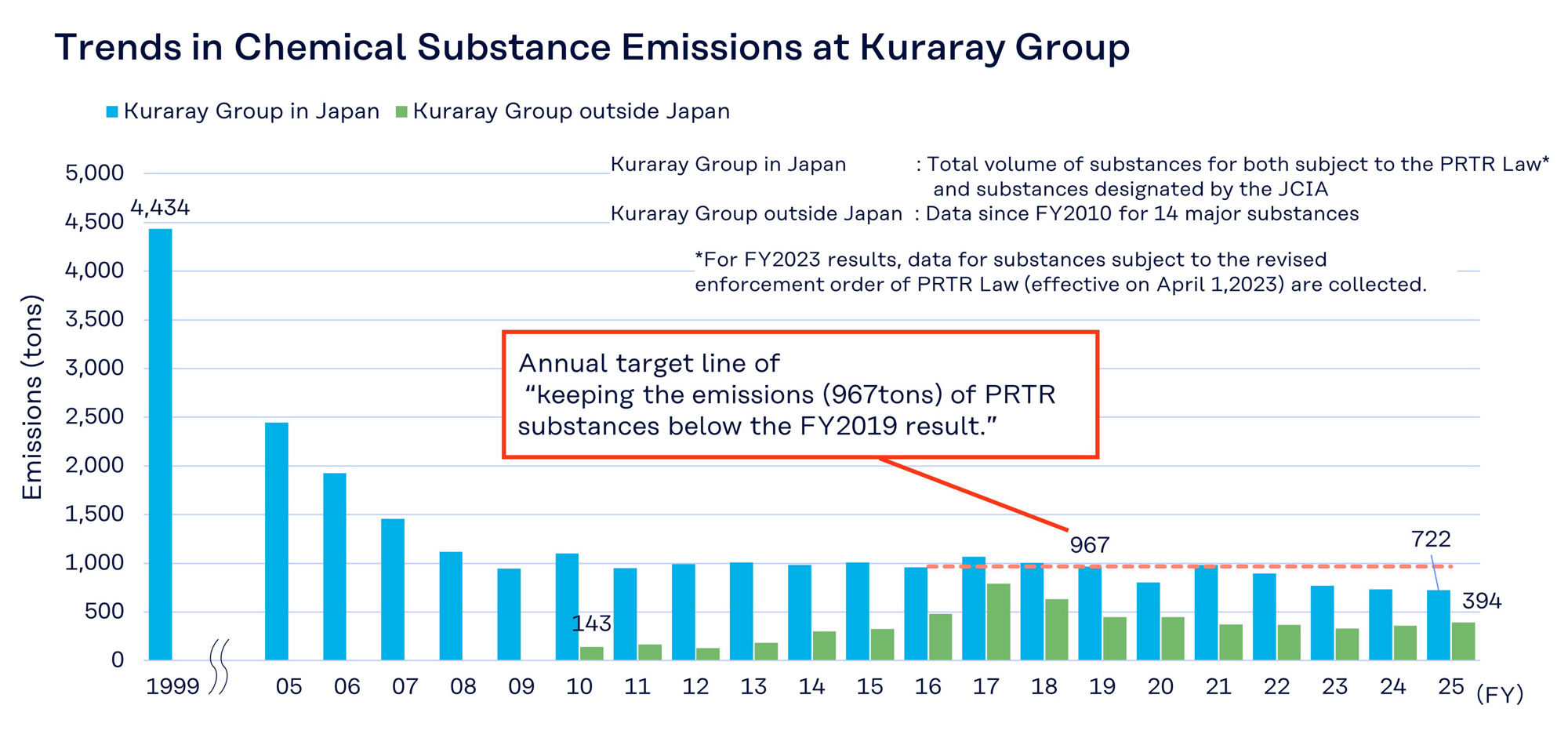
The Kuraray Group in Japan had made a major capital investment until around 2008 to reduce emissions of chemical substance, and has achieved about an 80% reduction compared to 1999. Since then, we have set limits on the amount of Japan Chemical Industry Association (JCIA)-designated Pollutant Release and Transfer Register (PRTR) substances* under the concept that, even if the scale of business expands, we will not increase emissions outside production sites from the base year. To achieve this target, when considering construction of new production facilities, we examine and carry out investment projects with consideration of measures to prevent an increase in emissions of chemical substances. In 2025, emissions decreased from 733 tons in 2024 to 722 tons, maintaining a level below the target of 967 tons. Going forward, we will continue to take measures to prevent an increase in emissions.
*
Substances subject to the PRTR Law and substances designated by the Japan Chemical Industry Association
The Kuraray Group outside Japan is committed to complying with stringent regulations on chemical emissions in each country and region where production sites are located, and to implementing quantitative management of emissions. Until 2017, total emissions were on an upward trend due to business integration and the construction and expansion of production facilities. However, emissions have been decreasing since 2018, following the expansion of exhaust gas treatment equipment at some sites and improvements in operational control. In 2025, emissions increased from 362 tons in 2024 to 394 tons, partly due to efforts to expand and improve the coverage of data collection across the Kuraray Group outside Japan.
【Notes】As a result of the change in months in each fiscal year, the environmental data and information contained in this report including graphs are as follows.
- Before fiscal 2013: Actuals in 12 months from April to March of the following year
- Fiscal 2014: Actuals for 9 months from April to December + Actuals for January to March 2014 (or estimated value) [Partially overlaps with fiscal 2013]
- After fiscal 2015 : Actuals for 12 months from January to December
Effective Use of Waste
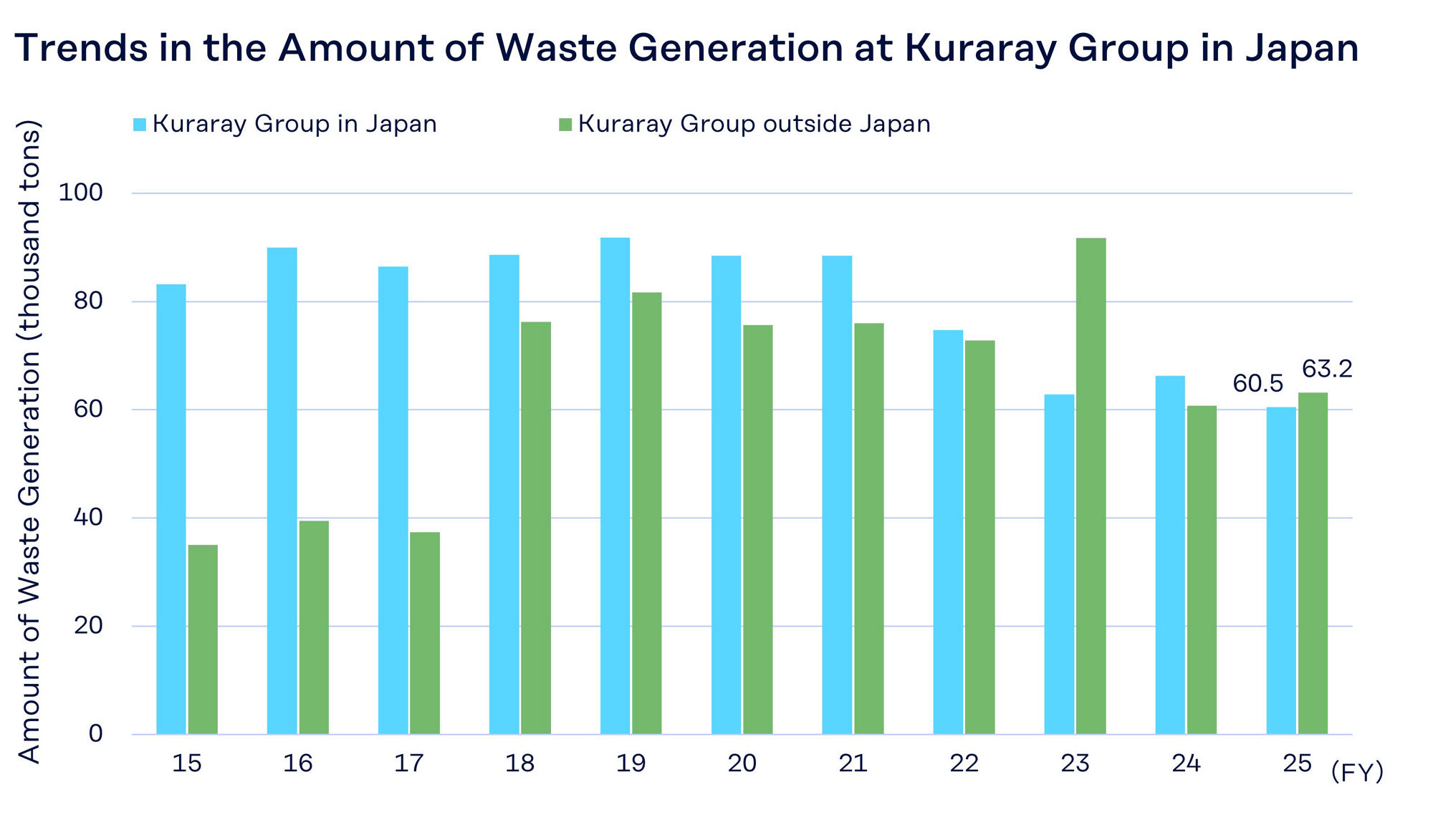
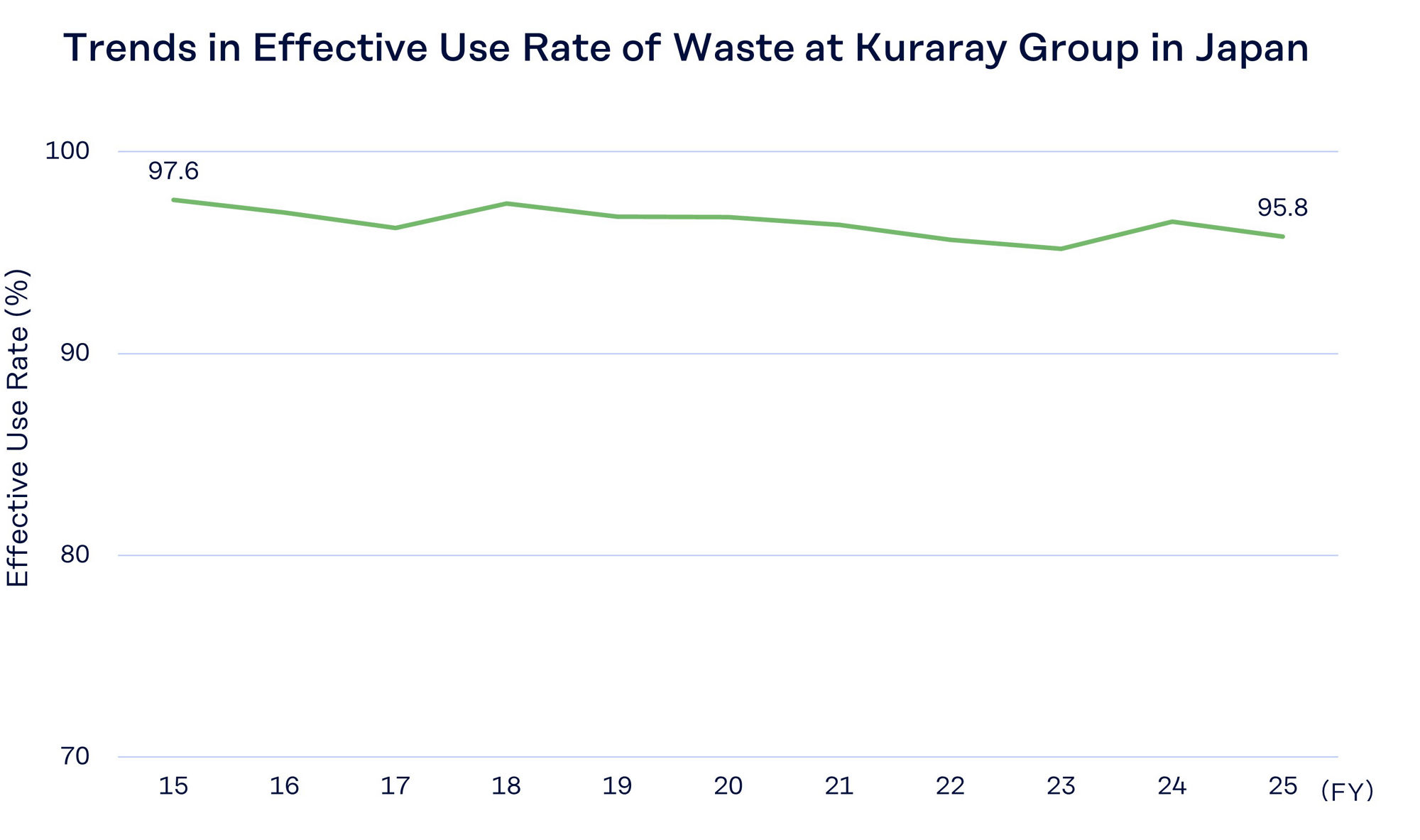
Total waste generation of the Kuraray Group in Japan in 2025 decreased from 66.3 thousand tons in 2024 to 60.5 thousand tons. This decrease was primarily attributable to a reduction in particulates generated from fuel combustion due to the long-term shutdown of in-house power generation facilities at certain sites for maintenance. In addition, measures equivalent to a reduction of 1.6 thousand tons of waste generation were implemented at each site and affiliated company plants, such as improving product yields, sorting and collecting waste for reuse as raw materials. Furthermore, efforts were made to promote the effective use of waste through recycling and energy recovery, resulting in an effective utilization rate of 95.8%. In recent years, regulations on waste exports have become increasingly stringent, and, in Japan, it remains challenging to secure waste treatment contractors. Going forward, we will continue to implement measures to reduce waste generation.
Total waste generation of the Kuraray Group outside Japan in 2025 increased from 60.8 thousand tons in 2024 to 63.2 thousand tons. This increase was mainly attributable to business acquisitions, including the acquisition of the vinyl acetate business in 2014 and the activated carbon business in 2018, as well as a temporary increase in waste generation at certain production sites in 2023. In 2024, waste generation decreased due to planned facility shutdowns at multiple sites in the United States and production suspensions at some sites for inventory adjustments. However, in 2025, waste generation increased as operating rates increased. In addition, affiliated companies outside Japan are also engaged in activities to improve product yields and collect and effectively use waste materials generated at our production sites. Going forward, each production site will continue to comply with local legal requirements and work on measures to reduce waste generation.
The sales intensity of waste generation for the Kuraray Group, which was set as the target for reduction of environmental impacts in the Sustainability Medium-Term Plan for Planet, reduced by 39.1% (improvement) in 2025 compared with 2019, far exceeding our target of the "Reduction (improvement) of 5% or more in 2026". Going forward, we will continue to work on further improvement of sales intensity through the activities of various measures for waste reduction.
<"Large-volume waste generators" under the Act on Promotion of Resources Circulation for Plastics>
(large-volume waste generators: those generating 250 tons or more per year of plastic product industrial waste, etc.)
The table below shows the business operators in the Kuraray Group that fall under the category of "large-volume generators" under the Plastic Resource Circulation Act in 2025. The Kuraray Group makes effective use of most of the generated industrial waste of plastic-using products, etc. through recycling and heat recovery. In addition, waste and other materials containing vinyl chloride generated by one of the affiliated companies are being disposed of by final disposal (in landfill) due to the difficulty of recycling and energy recovery, but we are switching some of the waste to uses that can be utilized as effectively as possible. We will continue to implement measures to reduce the amount of waste generated by working on improving process yields and other measures, as well as promoting the effective use of the waste generated.
| Company | Amount of waste (ton) | Effective use (ton) | Final disposal (ton) | Effective utilization rate | Final disposal rate |
|---|---|---|---|---|---|
| Kuraray Co., Ltd. | 18,810 | 18,487 | 76 | 98.3% | 0.4% |
| Kuraray Saijo Co., Ltd. | 295.0 | 294.8 | 0.2 | 99.9% | 0.1% |
| Kuraray Plastic Co., Ltd. | 260 | 98 | 163 | 37.5% | 62.5% |
Effective Use of Water Resources
The Kuraray Group, including affiliated companies outside Japan, is not engaged in production activities in areas where our business activities significantly impact on local water resources. However, we have been engaging in business activities recognizing that water resources are vital.
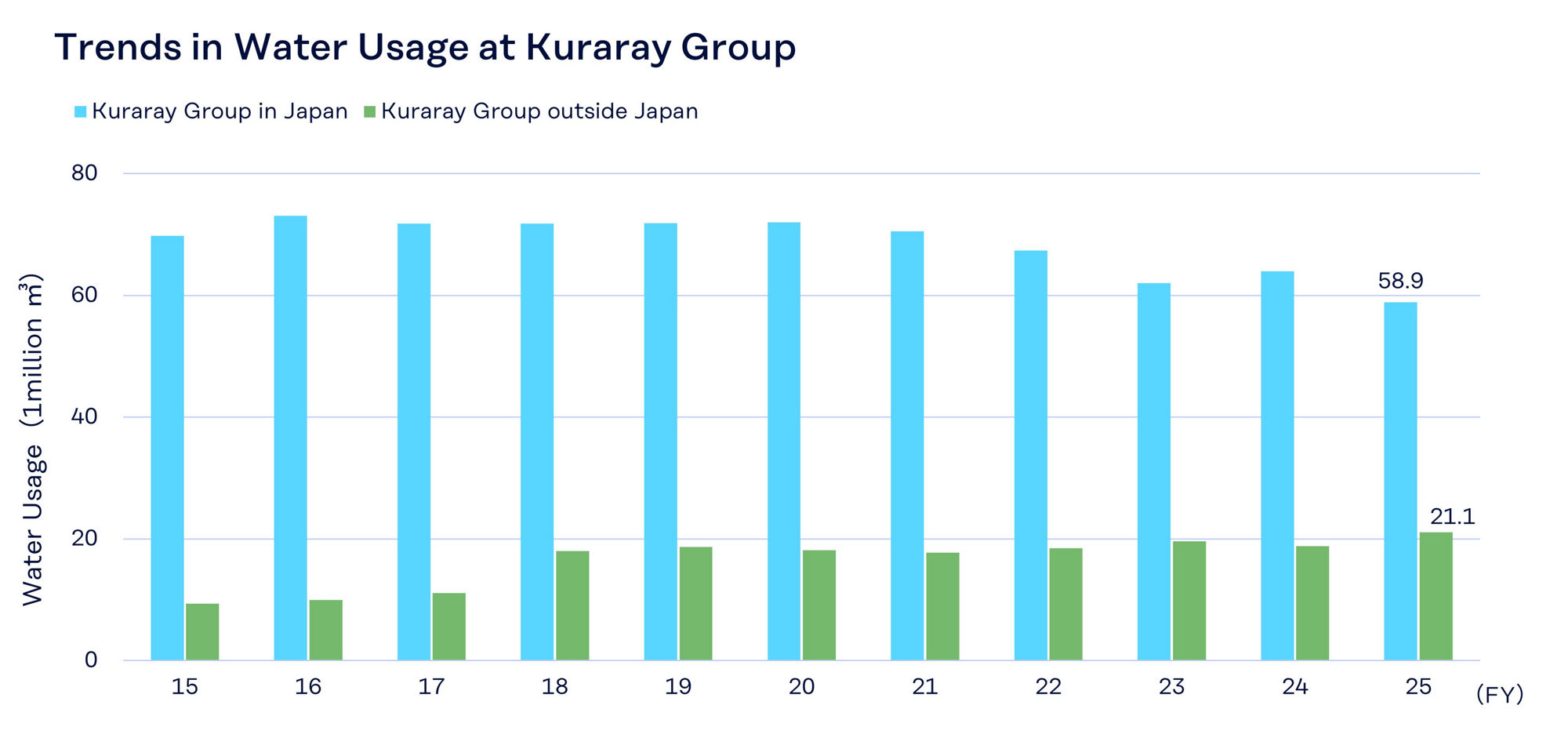
In 2025, water consumption (excluding seawater) of the Kuraray Group in Japan decreased from 64.0 million m3 in 2024 to 58.9 million m3. This decrease was primarily due to a reduction in water usage for steam boilers, resulting from planned long-term shutdowns of in-house power generation facilities at some sites for maintenance. Although Kuraray production sites in Japan are located in areas with relatively abundant water resources, we recognize the need to consider long-term prospects for water supply, such as the risk of a water shortage caused by climate change due to global warming, in our business operations. We also continue to promote “water reuse”, such as reusing cooling water for boiler use. We will keep track of water consumption trends while continuously reducing our water consumption and effectively using water resources.
Water consumption of the Kuraray Group outside Japan has increased since 2014 due to the incorporation of businesses through M&A, such as the acquisition of the vinyl acetate business and the activated carbon business, but it has remained nearly constant since then. In 2024, water consumption decreased due to reduced cooling water usage resulting from planned facility shutdowns at some sites. However, in 2025, as operating rates increased, water consumption rose from 18.8 million m3 in 2024 to 21.1 million m3. Across affiliated companies outside Japan, measures to reduce water consumption, such as improving product yields and reusing recovered water, have been continuously implemented, thereby minimizing the increase in water consumption.
The sales intensity of water usage in the Kuraray Group outside Japan, which was set as the target for reduction of environmental impacts in the Sustainability Medium-Term Plan for Planet reduced by 13.2% (improvement) in 2025 compared with 2019, far exceeding our target of the "Reduction (improvement) of 5% or more in 2026". Going forward, we will continue to work on further improvement of sales intensity through the activities of various measures for water usage reduction.
Conservation of Biodiversity
The Kuraray Group believes that continuing our efforts to implement measures in global warming prevention, control of chemical substance emissions, reduction and effective use of waste, and effective use of water resources will lead to biodiversity conservation. We formulated the Action Policy for Biodiversity Conservation and have been promoting activities and the development of technologies and sale of products that contribute to biodiversity conservation. Refer to following examples of environmental conservation activity, employee volunteers at some Kuraray plants engage in forest conservation activities, cleanup activity, and endangered species protection activities, in cooperation with local governments and others.
<Examples of environmental conservation activities>
| Kurashiki Plant |
|
|---|---|
| Okayama Plant |
|
| Saijo Plant |
|
| Niigata Plant |
|
| Kashima Plant |
|
| Tsurumi Plant |
|
| Kuraray America, Inc. |
|
| MonoSol, LLC |
|
| Calgon Carbon |
|
| Kuraray Mexico |
|