
Updated on July 07, 2026 Corporate Governance
- Basic Views
- Corporate Governance System
- Directors / Members of Audit & Supervisory Board / Outside Directors and Outside Members of Audit & Supervisory Board
- Compensation System / Cross-Shareholdings
Basic Views on Corporate Governance
The Company believes that maintaining appropriate relationships with various stakeholders and fulfilling social responsibilities through establishing a corporate governance system that ensures effective and fair management will contribute to the long-term, sustainable enhancement of corporate value.
The Company has adopted the governance system of “a company with Audit & Supervisory Board.” Under this framework, the Company has established corporate governance centered on its Board of Directors and Audit & Supervisory Board to improve the effectiveness of the supervisory and monitoring function while maintaining management efficiency and to handle issues, including management compensation, selection of new company officers, internal control and risk management.
Through the above, the Company believes the effectiveness of the supervisory and monitoring function will be improved while maintaining management efficiency, contributing to the long-term and sustainable enhancement of corporate value.
2003
|
|
2008
|
|
| 2016 |
|
| 2017 |
|
| 2018 |
|
| 2020 |
|
| 2022 |
|
| 2024 |
|
| 2025 |
|
Corporate Governance System (As of July 01, 2026)

Board of Directors
The Board of Directors, which meets at least once a month, sets by laws for the Board, deliberates and decides on statutory matters and other key management issues, and supervises business execution. The Board of Directors is chaired by the Chairman and Director. The maximum number of Directors is set at 12, to facilitate agile management decision-making by the Board, and the term of office is set at one year to clarify their responsibilities to shareholders. There are currently 11 incumbent Directors, of whom two are female and one is non-Japanese. Four are Outside Directors, who possess a wealth of experience in and broad insight into the economy, finance, and corporate management, and are responsible for supervising management from an independent, third-party standpoint.
Board of Directors — Overview and Operation
Chair: Masaaki Ito, Chairman and Director

[Fiscal 2025]
Convened: 15 times
Attendance rate: 99.4%
Main Proposals and Reports:
- Management plans
- Verification of significance of holding cross-held shares
- Status and operation of internal control systems
- Evaluation of the effectiveness of the Board of Directors
- Acquisition of U.S. startup
- Divestiture of non-core businesses and downsizing/withdrawal from unprofitable businesses
- Virtual power purchase agreements (VPPA), etc.
Evaluation of the Effectiveness of the Board of Directors
Every fiscal year, the Company evaluates and verifies the effectiveness of the Board of Directors to make improvements as needed. In fiscal 2025, the Company conducted a survey of all directors and members of Audit & Supervisory Board with advice from external organizations, and, based on a report of the aggregated results, analyzed and evaluated the results at a meeting of the Board of Directors.
From the responses to the questionnaire, generally positive evaluations were received, including active discussions and the strengthening of each director’s expertise, which has improved effectiveness, and it was confirmed that the effectiveness of the Board of Directors is secured. On the other hand, it was also recognized that there are issues that must be addressed to further enhance effectiveness, which will be reflected in initiatives for next fiscal year and beyond.

Question Content (40 questions in total)
- Composition of the Board of Directors
- Board meeting agendas
- Operation of Board meetings
- Support system for Directors and Audit & Supervisory Board Members, etc.
Key Comments
- In the future, it will be better to have a structure where at least one internal director is female. It is imperative that personnel with skills and motivation are identified and nurtured.
- The number of non-Japanese directors should be increased to further strengthen the governance structure for overseas businesses.
- The atmosphere of the Board facilitates free discussions, and it is important that this environment continues to be valued while further deepening discussions on medium- to long-term issues and strategies.
- In light of recent international developments, deliberations that take into account steps to ensure resilience and the Company’s risk measures based on changes in external environments have grown even more important.
- Depending on the topic, subcommittee meetings should be held to allow for more exhaustive discussions.
- The Company has a support system in place for directors and members of Audit & Supervisory Board so they can benefit from briefings on agenda items, site visits both in Japan and overseas, and regular dialogue with the internal audit department.
- With regard to discussions on the top executive succession plan, it will be important to further establish and enhance the process and substance going forward.
Audit & Supervisory Board
The Audit & Supervisory Board consists of four Members, including three independent Outside Members of Audit & Supervisory Board. Three are male and one is female. The Audit & Supervisory Board convenes monthly, in principle. The Members of Audit & Supervisory Board meet regularly with the Independent Auditor and receive reports on audit planning, implementation status, and audit content. They also receive reports on the results of internal audits from the Corporate Auditing Division, the in-house audit department. In addition, the Members of Audit & Supervisory Board serve as corporate auditors at major Group companies and conduct Group company audits as appropriate. They also attend the periodic Group Auditor Liaison Meetings consisting of the Group company auditors to gain information on the respective companies. There are also staff to assist the Members of Audit & Supervisory Board in carrying out their duties.
Audit & Supervisory Board — Overview and Operation
[Fiscal 2025]
Convened: 13 times
Attendance rate: 100%
Main Topics Considered:
- Legal compliance, compliance framework
- Quality assurance framework
- Implementation and operation status of internal control systems at various Group companies
- Response measures related to serious accidents, epidemics, natural disasters, information leaks, and other management risks
- Efforts to secure and cultivate talent for the next generation, retain talented personnel, pass on skills, heighten employee engagement, etc.
Corporate Advisory Committee
The Company has established a Corporate Advisory Committee composed of Outside Directors and Outside Members of Audit & Supervisory Board and outside experts to serve as an advisory body to the Board of Directors. The committee works to improve the transparency, fairness, and objectivity of decision-making on important management matters such as the appointment and compensation of Directors and further enhance corporate governance. Corporate Advisory Committee meetings are held twice a year in principle.
The committee consists of seven members: four Outside Directors (Ms. Keiko Murata, Mr. Satoshi Tanaka, Ms. Naoko Mikami, and Mr. Toshifumi Mikayama), one Outside Member of Audit & Supervisory Board (Ms. Tomomi Yatsu), and two outside experts (Mr. Go Egami [listed under the name Mr. Haruki Kohata] and Mr. Jun Hamano). The committee is chaired by an Outside Director.
Corporate Advisory Committee — Overview and Operationn
Chair: Satoshi Tanaka, Outside Director
[Fiscal 2025]
Convened: 2 times
Attendance rate: 92.9%
Main Discussions and Reports:
- Compensation for directors
- Officer personnel matters
- Top executive succession planning
Risk Management and Compliance Committee
The committee, under the direct control of the President, is tasked with ensuring the appropriate management of risks that could have a significant impact on business management, thorough compliance with laws and regulations and corporate ethics, and fair business practices. The committee identifies material risks and proposes them to the President in its regular monitoring of risks for Group companies. The President then specifies those that require countermeasures as management risks and appoints a supervising officer for each risk to implement risk avoidance and mitigation measures. This committee also reports on a range of activities to the Board of Directors and incorporates their direction in future risk response measures.
Sustainability Committee
In 2022, the Kuraray Group established a Sustainability Committee chaired by the president to replace the CSR Committee.
This committee deliberates on sustainability-related issues and response policies for the Group at the management level, makes decisions swiftly, and monitors the progress of various measures. In addition, matters deemed important by this committee are submitted to or reported to the Board of Directors for the Board’s opinions to be reflected in initiatives to address sustainability issues.
Major Agenda Items for Fiscal 2025
- Virtual power purchase agreements (VPPA) in the United States
- Emissions trading scheme (GX-ETS)
- Progress of the CCUS*1 Project
- Enhancement of evaluation of environmentally friendly products using the Kuraray PSA*2 system
- Implementation of a global sustainable procurement questionnaire, etc.
*1 CCUS: Carbon Dioxide Capture, Utilization and Storage
*2 PSA: Portfolio Sustainability Assessment
▽ Policies for the Appointment of the Candidates for Directors and Members of Audit & Supervisory Board
▽ Skills Matrix
▽ Succession Plan for Top Executives
▽ The Independence Standards for Outside Directors and Outside Members of Audit & Supervisory Board
▽ Reason for the appointment of Outside Directors and Members of Outside Audit & Supervisory Board
▽ Support System for Outside Directors and Outside Members of Audit & Supervisory Board
Policies for the Appointment of the Candidates for Directors and Members of Audit & Supervisory Board
The Company believes that maintaining appropriate relationships with various stakeholders and fulfilling social responsibilities through establishing a corporate governance system that ensures effective and fair management will contribute to the long-term, sustainable enhancement of corporate value.
The Company has adopted the governance system of “a company with Audit & Supervisory Board.” Under this framework, the Company has established corporate governance centered on its Board of Directors and Audit & Supervisory Board to improve the effectiveness of the supervisory and monitoring function while maintaining management efficiency and to handle issues, including management compensation, selection of new company officers, internal control and risk management.
Through the above, the Company believes the effectiveness of the supervisory and monitoring function will be improved while maintaining management efficiency, contributing to the long-term and sustainable enhancement of corporate value.
Skills Matrix
The Company has a broad array of businesses globally, including resins, chemicals, activated carbon, and fibers & textiles. In light of the characteristics of each business, we believe that in order to ensure appropriate and agile decision-making and supervision over execution, the Board of Directors and Audit & Supervisory Board must demonstrate expertise and business experience in a variety of fields, as well as diversity in such terms as gender and nationality.
To ensure this, the Company has identified nine areas of knowledge, experience and expertise that are particularly expected of directors and Audit & Supervisory Board members: Corporate Management, Global, Sales and Marketing, Production and Equipment Technology, R&D, Legal Affairs and Risk Management, Finance and Accounting, Environment and Society, and Human Resources and Labor Management.

* The above table shows up to four areas of knowledge or experience possessed by Directors or Members of Audit & Supervisory Board. It does not represent all of their knowledge or experience.
Succession Plan for Top Executives
We are continuously discussing a succession plan to foster future management at the meetings of the Board of Directors and the Corporate Advisory Committee with the objective of ensuring management continuity and enhancing corporate value over the medium to long term. Having clarified the experiences and skills required of top executives, we are now compiling a list of potential successors and examining ideal management structures from multiple perspectives.
In terms of development, we provide training to personnel who could become successor candidates and assign them to important positions at the department head level and above, enabling them to gain practical experience while evaluating their growth and suitability. We also create opportunities for deepening mutual understanding, such as meetings during which opinions can be exchanged, so that outside directors can gain insight into the qualities and abilities of the candidates.
Also, we regularly provide executives with the training necessary to fulfill their roles and responsibilities. For the Company’s outside directors, we provide them with information about the Group’s management circumstances and a business overview, and implement initiatives to deepen their understanding of the Group, including site visits to workplaces in Japan and overseas and meetings with employees.
The Independence Standards for Outside Directors and Outside Members of Audit & Supervisory Board
The Company judges that its Outside Directors and Outside Members of Audit & Supervisory Board and the candidates for the Outside Directors and Outside Members of Audit & Supervisory Board are fully independent of the Company if they do not fall under any of the following items:
- A business executive of the Group
- A counterparty that has transactions principally with the Group, or its business executive thereof
- A major business partner of the Group, or its business executive thereof
- A major lender of the Group, or its business executive thereof
- A counterparty that receives a large amount of donations from the Group, or its business executive thereof
- A major shareholder of the Company (who possesses 10% or more of the total voting rights either directly or indirectly), or its business executive thereof
- A business executive of the party whose major investor (who possesses 10% or more of the total voting rights either directly or indirectly) is the Group
- A consultant, certified public accountant, or other accounting professional, attorney, or other legal professional who receives a large amount of monetary or other assets from the Group other than the executive remuneration (in case of a legal entity, association, or other organization, a person belonging thereto)
- A person who belongs to an accounting firm that conducts the statutory audit of the Company
- A person who has fallen under the above criterion (1.) in the past 10 years
- A person who has fallen under any of the above criteria (2.) through (9.) in the past three years
- A person whose position constitutes him/her as having an Outside Officer’s interlocking relationship with the Group
- A relative of the persons listed in the above criteria (1.) through (11.)
Even in cases where a person falls under any of the above items, if the person is deemed to be appropriate for the post of independent Outside Directors and Outside Members of Audit & Supervisory Board in light of his/her personality, knowledge, and other qualities, the Company may appoint him/her as an independent Outside Director and Outside Member of Audit & Supervisory Board on the condition that the reasons why the person is deemed appropriate for the post are explained to the public.
Reason for the appointment of Outside Directors and Members of Outside Audit & Supervisory Board
Name | Independent | Reasons of Appointment | |
|---|---|---|---|
| Outside Director | Keiko Murata | 〇 | Ms. Keiko Murata has been appointed as Outside Director, because based on her experience in economic administration and analysis of Japan and overseas at the Cabinet Office, and deep insight as a professor of a university and graduate school, she can be expected to provide opinions and suggestions that would be useful for helping to improve the Company’s management and corporate value. |
| Outside Director | Satoshi Tanaka | 〇 | Mr. Satoshi Tanaka has been appointed as Outside Director, because based on his wealth of experience and broad insight gained through his service as Director responsible for the Corporate Staff Unit and Representative Director of Mitsui & Co., Ltd., he can be expected to provide opinions and suggestions that would be useful to the Company’s management. |
| Outside Director | Naoko Mikami | 〇 | Ms. Naoko Mikami has been appointed as Outside Director because she can be expected to leverage the wealth of experience and broad insight gained through her involvement in corporate management in Japan and the production technology field to provide opinions and suggestions that would be useful to the Company’s management. |
| Outside Director | Toshifumi Mikayama | 〇 | Mr. Toshifumi Mikayama has been appointed as Outside Director because he can be expected to leverage the wealth of experience and broad insight gained through his many years of involvement in corporate management, R&D and overseas business promotion to provide opinions and suggestions that would be useful to the Company’s management. |
| Outside Member of Audit & Supervisory Board | Tomomi Yatsu | 〇 | Ms. Tomomi Yatsu has been appointed as Outside Member of Audit & Supervisory Board because she has broad insight as a certified public accountant and attorney at law and a wealth of experience as outside officer of other companies. |
| Outside Member of Audit & Supervisory Board |
Kenji Komatsu
| 〇 | Mr. Kenji Komatsu has been appointed as Outside Member of Audit & Supervisory Board because he has track records in management at many other companies both domestically and internationally, and he has a wealth of experience and broad insight developed through his career. |
| Outside Member of Audit & Supervisory Board | Nobuyuki Fujii | 〇 | Mr. Nobuyuki Fujii has been appointed as Outside Member of Audit & Supervisory Board because he has a wealth of experience at financial institutions and broad insight, and a track record at other companies as a Director. |
Support System for Outside Directors and Outside Members of Audit & Supervisory Board
Information is shared with Outside Directors and Outside Members of Audit & Supervisory Board by distributing and explaining in advance the proposals to be deliberated at the regular and extraordinary meetings of the Board of Directors. Staff from the Secretariat Group of the General Affairs Department assist in sharing this information with Outside Directors. Staff are appointed to assist Members of Audit & Supervisory Board, including Outside Members. Staff collect and provide information necessary for their auditing activities and offer other forms of support.
Directors’ Compensation System
Basic Policy
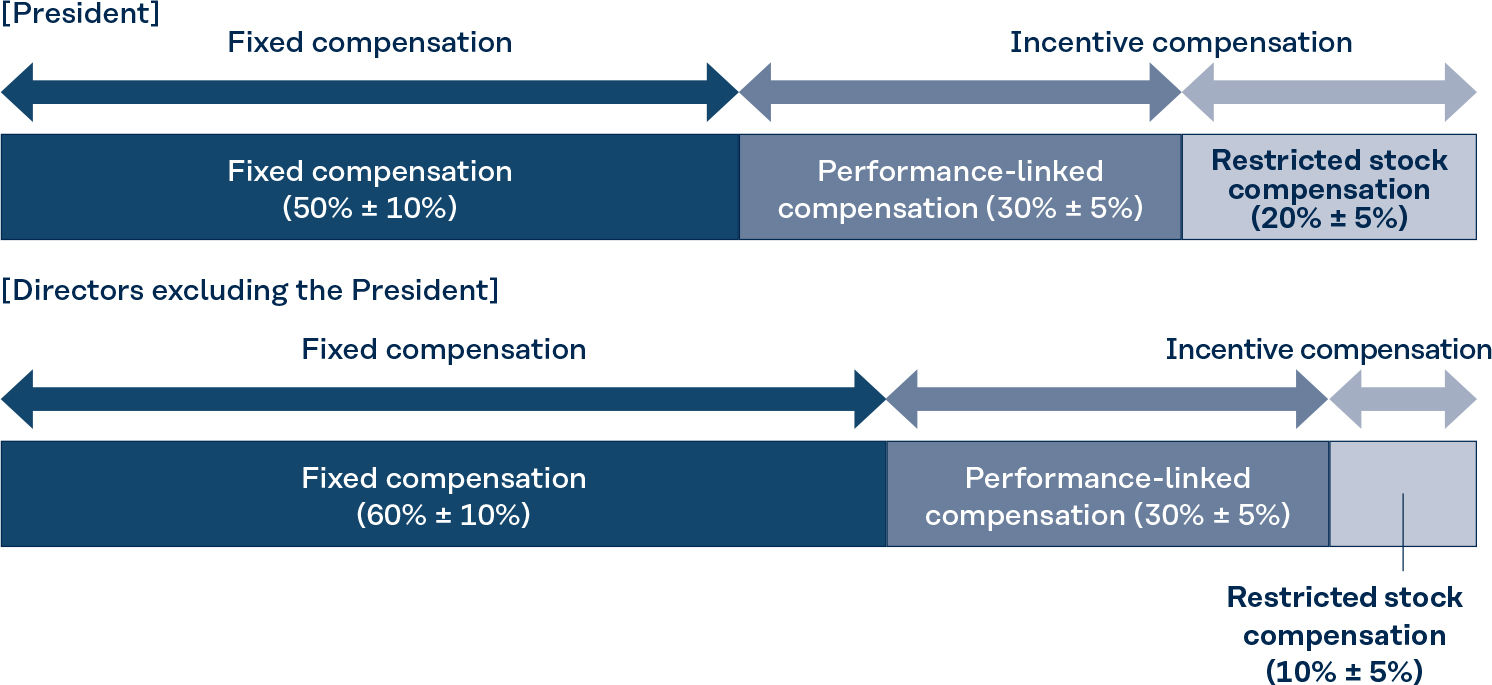
The Company’s basic policy for the compensation of its Directors is to have a competitive level and system of compensation that can secure and retain competent Directors fit for their positions and responsibilities to achieve long-term and sustainable improvements in corporate performance and corporate value. The compensation system for Directors comprises three parts: (1) fixed compensation as basic compensation per job responsibilities, (2) performance-linked compensation as an incentive to achieve yearly business results, and (3) stock-based compensation designed to enhance corporate value over the medium to long term and sharing of value with shareholders through appropriate corporate management, provided that compensation for Outside Directors will solely comprise fixed compensation without performance-linked or stock-based compensation, as their role is to supervise management from an independent standpoint.
The specific level and system of compensation will be verified and deliberated by the Corporate Advisory Committee, made up of Outside Directors, Outside Members of Audit & Supervisory Board and outside experts, on whether the level and system of compensation are appropriate, based on the results of a survey by a specialized external research institution on Directors’ compensation covering companies such as those listed on the Prime Market of the Tokyo Stock Exchange, and the salary of the managers of the highest level in the Company. The Board of Directors receives reports on the results from the Committee and gives it due consideration to determine the level and system of compensation. Details of the amount of compensation are provided in the executive compensation section of the securities report (Japanese only).
Composition of compensation, etc.
(Assuming the target set at the beginning of the year is achieved)
Method for determining the amount of compensation (incentives), etc.
| Performance-Linked Compensation System | The Company abolished the bonus scheme for Directors and introduced a performance-linked compensation system in July 2006, thereby strengthening the incentives of Directors to increase the Company’s corporate value. In addition, to respond to the increase in the amount of performance-linked compensation in conjunction with improved business performance, it was resolved to increase the maximum amount of annual monetary compensation to Directors from ¥450 million to ¥800 million (including ¥100 million annually for Outside Directors) at the Company’s 131st Ordinary General Meeting of Shareholders, held on June 22, 2012. Performance-linked compensation is not paid to Outside Directors. (Calculation Method) |
|---|---|
| Restricted Stock Compensation Plan | At the 140th Ordinary General Meeting of Shareholders held on March 25, 2021, the Company resolved to abolish the existing stock option plan*1 and introduce a restricted stock compensation plan, with the aim of incentivizing Internal Directors and Executive Officers to improve the Company’s corporate value in a sustainable manner as well as raise the degree to which they share value with shareholders. In view of changes in the stock price since the introduction of this plan, and in light of a potential increase in the total amount of monetary compensation to be paid to eligible Directors for granting restricted stock following inclusion in the plan of evaluation based on sustainability-related indicators, at the 144th Ordinary General Meeting of Shareholders held on March 27, 2025, the Company furthermore resolved that restricted stock compensation for Directors under the plan be capped at an annual amount of ¥180 million. The number of shares to be granted under the plan will not exceed 60,000 shares each year. Restricted stock compensation is not paid to Outside Directors. Monetary compensation linked to stock price (phantom stock) has been introduced in lieu of restricted stock compensation for Directors who are non-residents of Japan. (Calculation Method) |
The Company has set forth the policy on cross-shareholdings and standards for exercising voting rights pertaining to cross-held shares as follows.
1) Coming from the viewpoint of stable and long-term business operation, the Company may hold the shares of its business partners, etc., if maintaining and strengthening the relationships with such business partners are deemed to contribute to corporate value enhancement.
2) Regarding the shares held pursuant to the preceding paragraph (hereinafter, “cross-held shares”), the Company regularly examines economic rationality and significance of holding individual stock at the Board of Directors meetings in consideration of benefits and risks associated with such holding, capital cost and other factors. The Company will sell shares of stocks, as necessary, whose holding was deemed not to be appropriate based on the examination to reduce such stocks.
3) Concerning the voting rights pertaining to the cross-held shares, the Company appropriately exercises such voting rights in light of the objectives of shareholdings set forth in the preceding two paragraphs, taking into consideration the business conditions of the companies and potential impact to the business operation of the Company or a subsidiary of the Company (hereinafter “the Group”). Particularly, the Company carefully exercises such voting rights in a case where performance of the companies has been sluggish for a long period of time or a serious scandal has occurred or in a case where a proposal that would impair shareholders’ value was made.
Examination of the Propriety of Holding Cross-Held Shares
The Board of Directors regularly verifies the economic rationality and significance of holding shares (cross-shareholdings), and seeks to sell shares, as necessary, whose holding is deemed not to be appropriate, to reduce such stocks. In fiscal 2025, out of its crossshareholdings in listed companies, the Company sold all shares of eight companies and a portion of shares held in two companies. This brought the ratio of cross-shareholdings to net assets to 1.7% as of the end of fiscal 2025.
Status of Cross-Shareholdings
