
Materiality of Kuraray Group
- Materiality
- Materiality Specific Procedure
Materiality
The Kuraray Group identifies material issues related to us as materiality. The Kuraray Group reviewed its materiality in 2019, for five domains along with specific examples: “improving the natural environment,” “improving the living environment,” “effective use of resources and reduction of environmental impact,” “improving supply chain management,” and “building a ‘company that people can take pride in’.” Contributions to these revised material domains are being incorporated into the initiatives and targets of their respective Medium-Term Management Plan "PASSION 2026.”
Materiality of the Kuraray Group
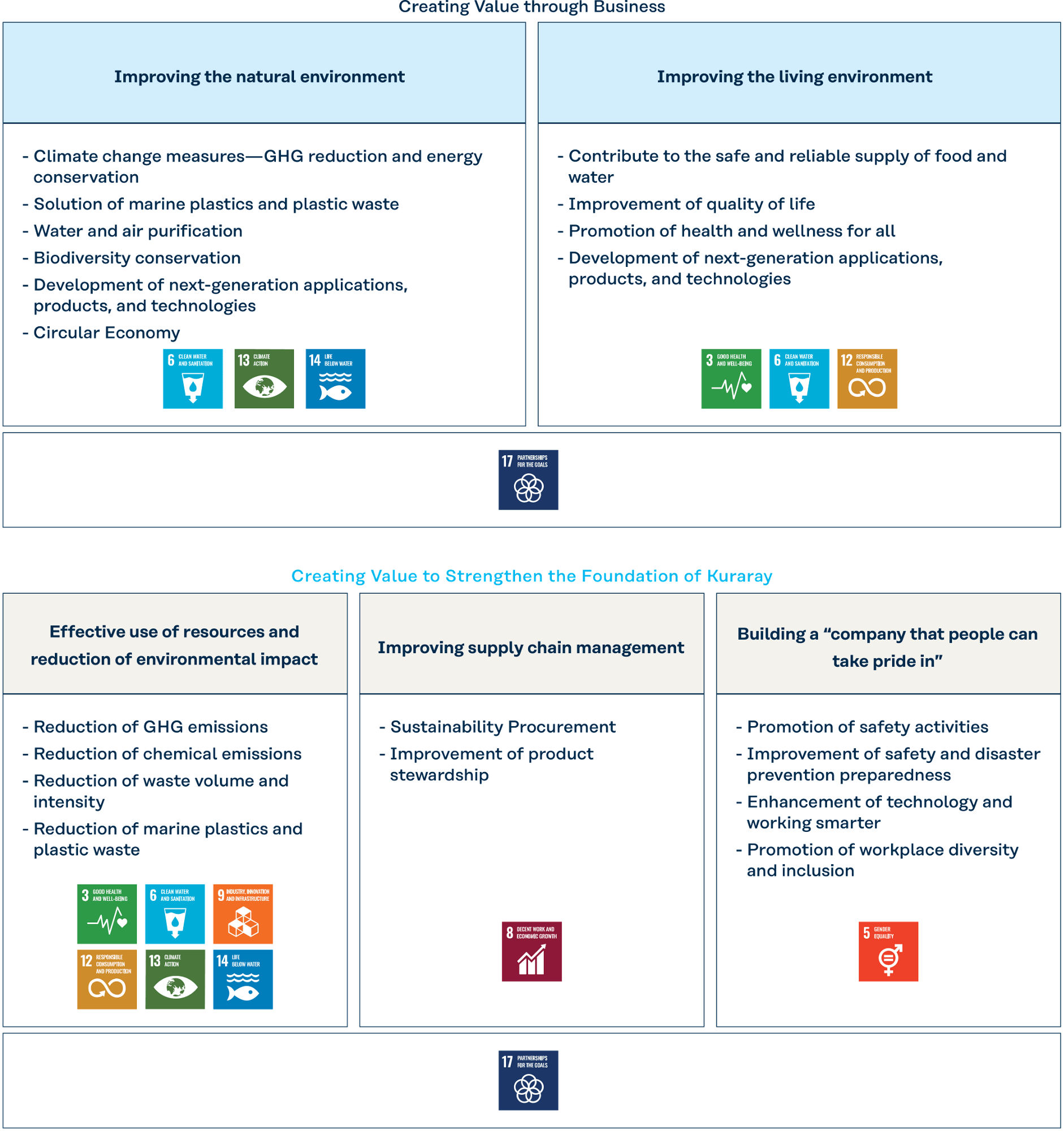
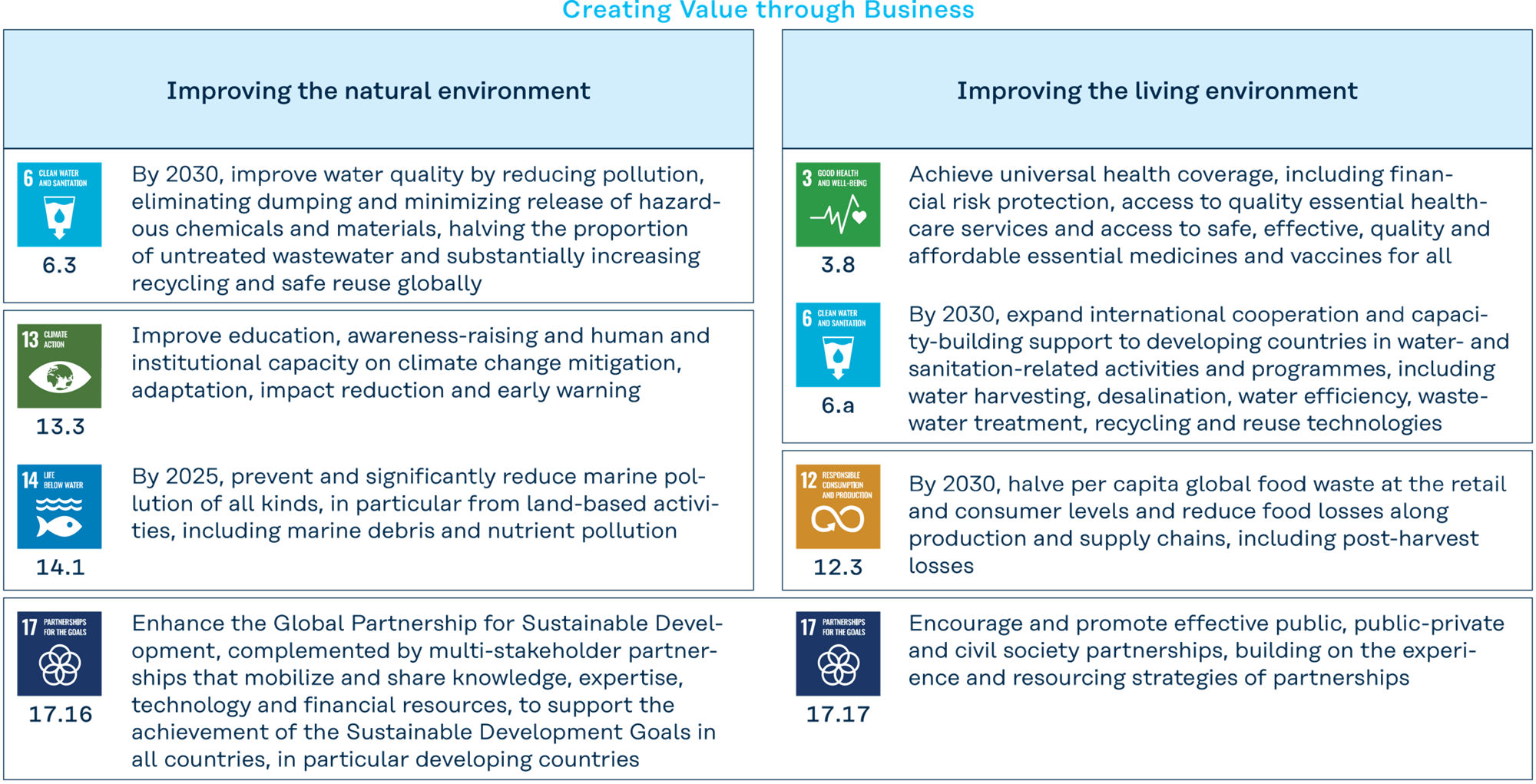
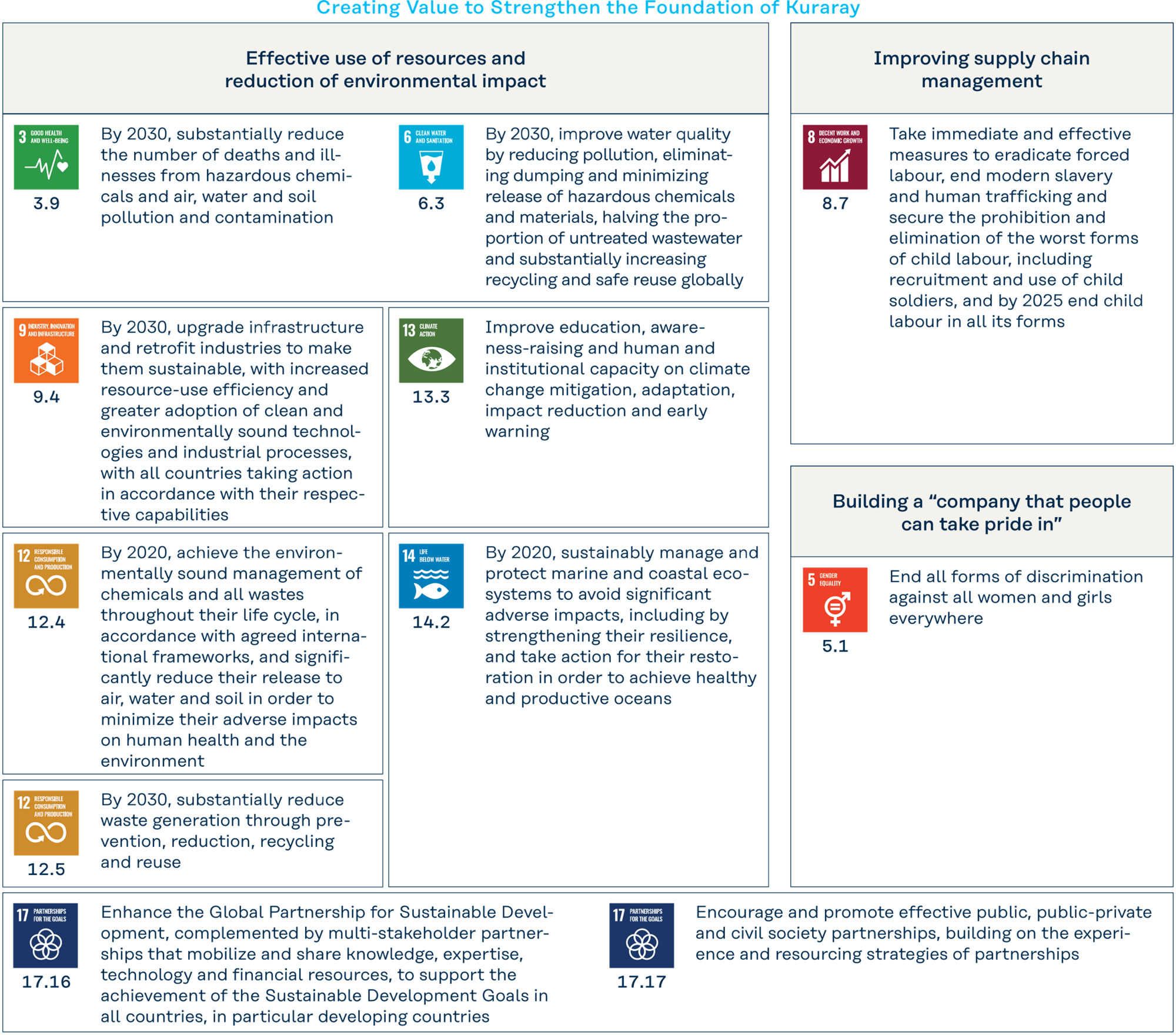
SDGs Linked to Kuraray's Materiality
In line with the review of materiality, material issues that the Kuraray Group should address have been identified from the terms of the SDGs, as shown below in “Procedure to identify materiality.”
Each material issue has been linked with the SDGs to clarify the relationship. This allows the Group’s sustainability activities to not only address the Group’s material issues but also contribute to achieving the target of the SDGs.
Relationships with stakeholders
The Kuraray Group’s business activities are supported by engagement with a broad range of stakeholders, including customers and consumers, shareholders and investors, suppliers and business partners, employees, local communities and government bodies. The Group will further deepen dialogue and collaboration with these stakeholders to enhance the value of our corporate activities as we work to solve our materiality.
| Involvement with Stakeholders | |
|---|---|
| Shareholders and Investors >IR | General shareholders’meetings, Business site tours (IR), Financial results briefings, Kuraray report, Sustainability website |
| Suppliers and Partners >Supply Chain Management | Purchasing activities, Safety councils, Sustainability evaluation of suppliers, etc. |
| Employees >HR Strategy | Global engagement survey, Labor-management consultations, Health and safety councils, Performance review, Internal newsletters, Trainings, Various events, etc. |
| Local Communities >Interaction with Society | Meetings with local community associations, Plant tours, Chemistry classes for boys and girls, etc. |
| Central and Local Government, NPOs and NGOs >Interaction with Society | Plant tours, Fire drills, Volunteer activities, etc. |
| Customers and Consumers | Sales activities, Trade shows, Web sites, Questionnaires, etc. |
Materiality Specific Procedure
Material issues (materiality) that the Kuraray Group should deal with on a priority basis have been identified in accordance with the following procedure. Materiality will be reviewed periodically in accordance with developments in the international community, changes in the business environment, and so on.
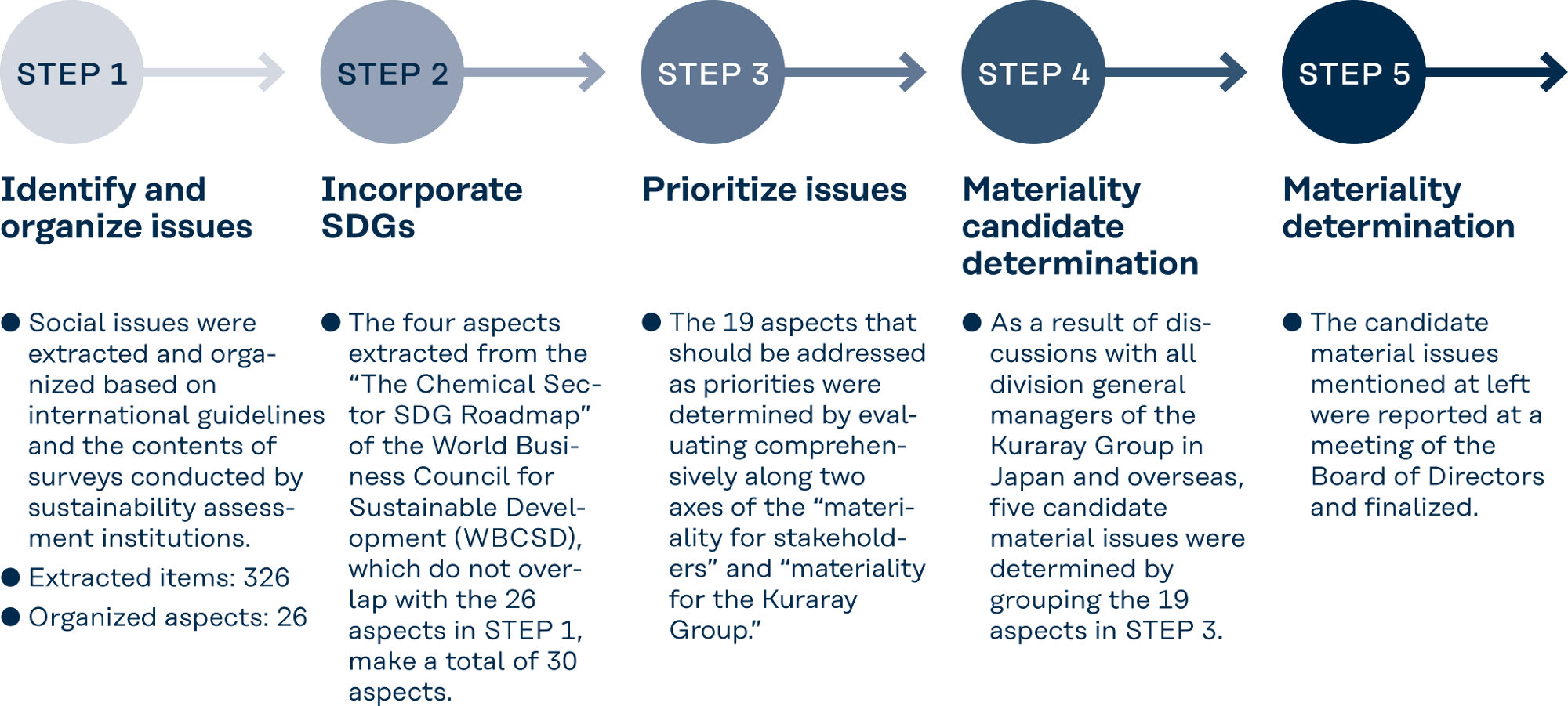
Step 1
The details of international guidelines and studies by sustainability assessment institutions that are used in extracting and summarizing social issues are as follows.
GRI, Environmental Reporting Guidelines (2012 Version), RBA, MSCI, FTSE4Good, DJSI, ISO26000, UN Global Compact, Green Paper EU, European Commission Strategy on CSR, German Stability Code, Circular Economy Package, American Chemistry Council
Step 2
The four aspects extracted from the “The Chemical Sector SDG Roadmap” of the World Business Council for Sustainable Development (WBCSD) are as follows:
Food disposal, water processing, climate change, and people’s health and wellness
Step 3
The materiality matrix of the Kuraray Group, which evaluates comprehensively by using the two axes of the “materiality for stakeholders” and “materiality for the Kuraray Group” is shown below.
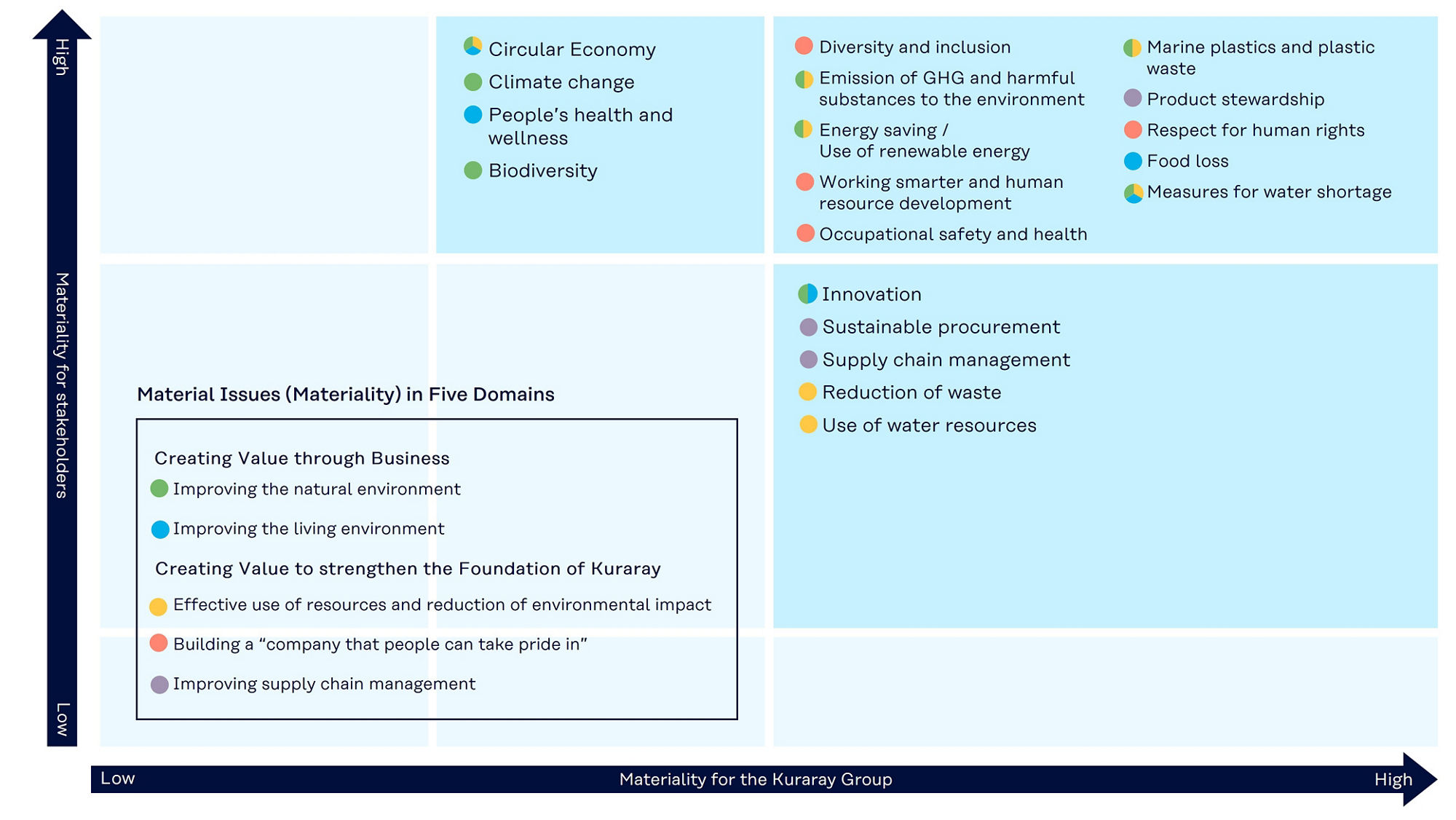
Materiality Matrix of the Kuraray Group
“Corporate governance,” “CSR management,” “ethics/code of conduct,” “risk management,” “relationships with stakeholders,” and “top statement” are to be dealt with separately from materiality.
As a result, materiality that the Kuraray Group is expected to deal with on a priority basis were identified as the following 19 aspects:
| 1 | 2 | 3 | 4 | 5 |
|---|---|---|---|---|
| Diversity and inclusion | Emission of GHG and harmful substances to the environment | Energy saving / Use of renewable energy | Working smarter and human resource development | Occupational safety and health |
| 6 | 7 | 8 | 9 | 10 |
|---|---|---|---|---|
| Marine plastics and plastic waste | Product stewardship | Respect for human rights | Food loss | Measures to water shortage |
| 11 | 12 | 13 | 14 | 15 |
|---|---|---|---|---|
| Circular Economy | Climate change | People’s health and wellness | Biodiversity | Innovation |
| 16 | 17 | 18 | 19 |
|---|---|---|---|
| Sustainable Procurement | Supply chain management | Reduction of wastes | Use of water resources |
Step 4
The 19 aspects identified in Step 3 were grouped to determine the following five items of “improving the natural environment,” “improving the living environment,” “effective use of resources and reduction of environmental impact,” “improving supply chain management,” and “building a ‘company that people can take pride in’” as materiality candidates.
In addition, “improving the natural environment” and “improving the living environment” were grouped under the broad category of “creating value through business,” with “effective use of resources and reduction of environmental impact,” “improving supply chain management,” and “building a ‘company that people can take pride in’” under “creating value to strengthen the foundation of Kuraray.”
| Materiality | The 19 aspects identified in the materiality matrix | |
|---|---|---|
| Creating Value through Business | Improving the Natural Environment | 2, 3, 6, 10, 11, 12, 14, 15 |
| Improving the Living Environment | 9, 10, 11, 13, 15 | |
| Creating Value to Strengthen the foundation of Kuraray | Effective Use of Resources and Reduction of Environmental Impact | 2, 3, 6, 10, 11, 18, 19 |
| Improving supply chain management | 7, 16, 17 | |
| Building a "company culture we can be proud of" | 1, 4, 5, 8 |
Step 5
The materiality candidates determined in Step 4 were reported to and approved by the Board of Directors.