Updated on March 25, 2026 Risk Management
- Risk Management Policy
- Issues and Measures in the Previous Fiscal Year
Risk Management and Compliance Implementation System
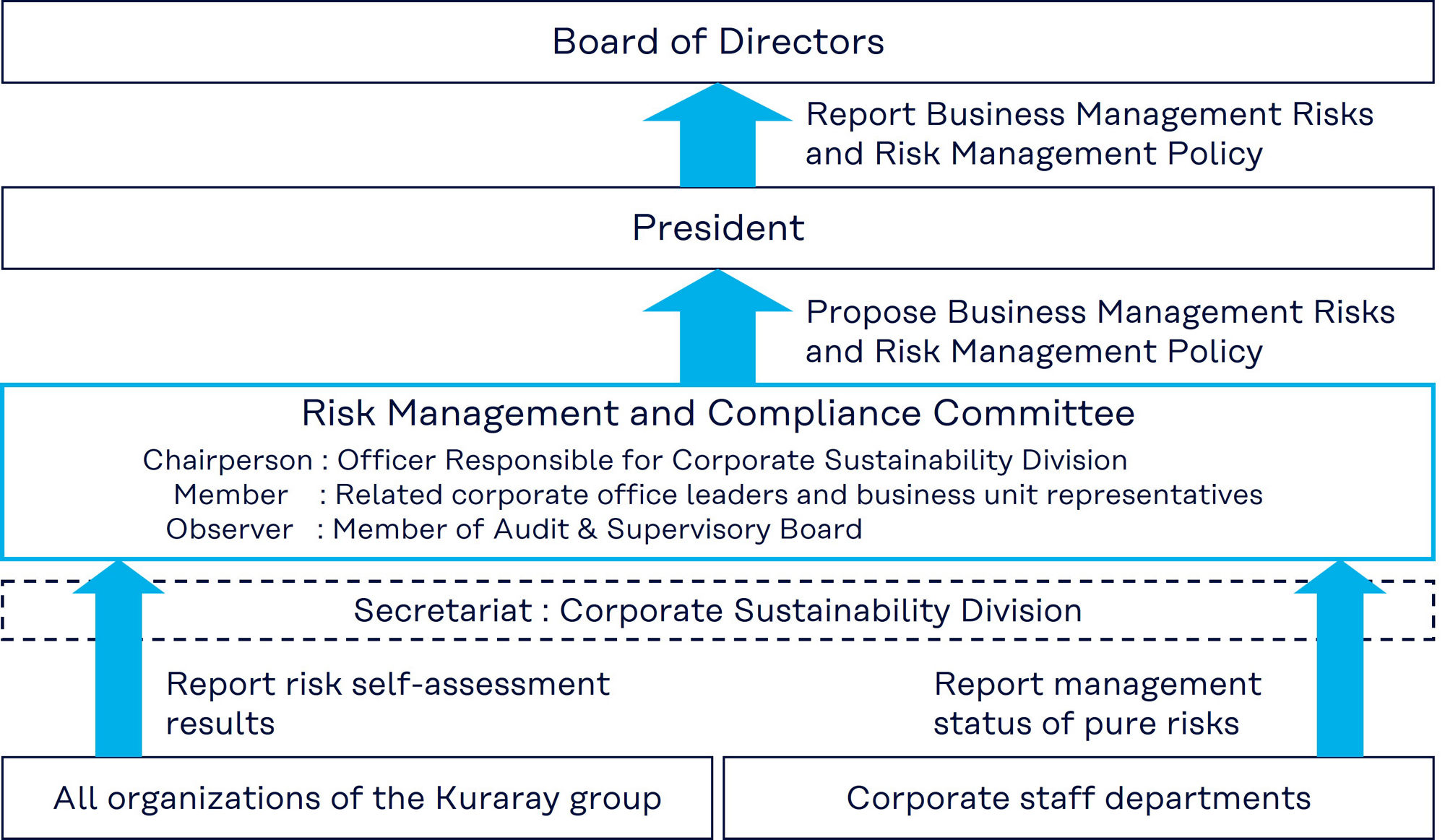
The Kuraray Group monitors risks regularly, led by the Risk Management and Compliance Committee, and identifies risks that could have a significant impact on business management. Such risks are proposed to the President, who then specifies those that are critical management risks, and priority countermeasures are carried out after deliberation by the Board of Directors. The Risk Management and Compliance Committee takes a role to manage the progress of priority countermeasures against business management risks as well as to ensure thorough compliance with laws and regulations and corporate ethics and the realization of fair business practices.
Risk Management System
Risk Management Policy
The Kuraray Group Risk Management Policy, which the President disseminates to each Group organization, consists of two elements: a long-term, ongoing Basic Policy encompassing overall Group risk management, and priority issues that are the focus for a particular fiscal year in light of the findings of risk analysis of the Kuraray Group and recent social conditions and trends. This framework allows flexible and prompt actions to be taken in response to changes in the risk environment while maintaining the basic approach to responding to risks. The Priority issues are those in which the President clearly indicates specific tasks for the organization to mitigate priority risks and directs the implementation of steady measures.
Kuraray Group Risk Management Policy for FY2026
Basic Policy
- Thoroughly prevent illegal and inappropriate actions that betray society’s trust.
- Thoroughly prevent accidents and disasters (safety incidents, occupational accidents, environmental pollution, product accidents, etc.) that threaten the safety and health of employees, local communities, customers, business partners, and others.
- When events occur that have a serious impact on our business or society, we prioritize earning society’s trust above all else. We will ensure the safety and health of our employees, communities, customers, partners, and others, and then implement measures to continue or quickly restore our business operations.
Priority Issues
In accordance with the above policy and in light of recent social and industrial trends, the following are designated as Priority issues for FY2026.
- Reduce the risk of leaks of confidential information, including personal data, through regular reviews and updates of information security systems, strict enforcement of confidential information management rules, and the steady implementation of improvement measures in operations. Additionally, enhance defensive measures to minimize operational impact from system failures during external attacks.
- To reduce the risk of safety incidents, we will continue implementing enhanced operational and equipment management measures at plants worldwide. Through planned on-site audits by our global PSM (Process Safety Management) audit team, composed of cross-functional members, we will objectively identify safety management issues, support their improvement, and implement global horizontal deployment of identified solutions to further reduce the risk of safety incidents across the entire Group.
- Considering the latest trends in the upstream supply chain and geopolitical factors, we will steadily implement measures to avoid and reduce procurement risks for raw materials and fuels of high priority products in each business’s BCP (Business Continuity Plan).
Risk Management
The Kuraray Group’s risk management is characterized by a two-tier approach. In terms of vertical risk management, each business division, office, plant, and affiliate identifies risks facing their own organization, independently evaluates such risks, and devises and implements an appropriate response. In terms of horizontal risk management, the responsible corporate departments conduct cross-organizational assessments of pure risks, such as natural disasters and violations of laws and regulations, that would have only negative impacts if they occur. Measures to adapt to risks associated with climate change are the purview of the Risk Management and Compliance Committee, which discusses the results of the various organizations’ annual risk self-assessments from the perspective of disaster response and business continuity. From these risks, the Risk Management and Compliance Committee discusses and identifies high-risk items that require a company-wide effort to mitigate. The President then designates these as critical management risks, reports them to the Board of Directors, and appoints an officer in charge as a supervising officer. In 2026, critical management risks are classified into three priority risks to be taken up as priority issues, and nine risks requiring ongoing monitoring, and proper measures are taken for both types of risks. For 2026, the priority risks we will address are Confidential Information Leakage, Safety Incident, and Interruption of Raw Materials and Fuel Supply. The risks requiring ongoing monitoring are Product Quality Risk, Chemical Substance regulations, Natural Disasters, Geopolitical Risk, Bribery, Antitrust Law Violations, Intellectual Property Risks, Harassment, and Respect for Human Rights. We will continue to implement appropriate measures for each.
Priority issues for 2025 and Specific Measures
In accordance with the Kuraray Group’s Risk Management Policy, and in light of recent social and industry trends, we designated the following as Priority issues for 2025 and implemented measures to address each.
Priority issues for 2025
- To reduce the risk of leakage/destruction of confidential information, we will introduce a globally unified information security system and improve the level of confidential information management by thoroughly enforcing management rules and steadily implementing improvement measures based on the results of monitoring the operation status.
- Continue to strengthen operation and facility management at sites around the world with the aim of reducing the risk of safety incidents. The Global PSM (Process Safety Management) Auditing Team, consisting of cross-organizational members, will objectively identify safety management issues through on-site audits and support improvements. They will also horizontally expand the issues discovered globally and share the knowledge to reduce future risks.
- Revise risk avoidance/mitigation measures for procurement of raw materials and fuels based on the latest trends in the supply chain upstream. We will steadily implement measures starting with raw materials and fuels for products that have high priority in the BCP or business continuity plan of each business.
Specific Measures
- To continuously strengthen confidential information management, we promoted initiatives to improve the detection accuracy of the large-volume download monitoring system and the automated download suspension system, both of which began operation in 2024, while also advancing the development of information management frameworks at overseas Group companies.
- In addition to the safety audits of overseas chemical plants conducted by the relevant companies and business units since 2019, the PSM Audit Team comprising global in-house experts was launched in 2022. Through these initiatives, we have strengthened the identification and mitigation of safety risks at overseas facilities. In 2025, the PSM Audit Team conducted on-site audits of four production bases, identified issues and provided recommendations for improvement.
- Reflecting the latest trends in the upstream supply chain, we revised the risks of raw material and fuel supply disruption as well as the corresponding avoidance and mitigation measures. Based on the analysis of priority products and the risks associated with supply disruptions of raw material and fuel for each business, we developed and implemented risk mitigation measures in order of priority.